Thursday, April 27, 2017

TOW #27 - Onward and Upward

This political cartoon is titled Onward and Upward which was illustrated by Bill Crawford.  This cartoon was created in 1967, at a time of great conflict during the Vietnam War.  Lyndon B. Johnson was president at the time, where he introduced the idea of the Great Society, which followed the pattern of the New Deal by FDR.  This “great society” was a set of domestic programs which aimed at eliminating poverty and racial injustice. But, these domestic required lots of spending, but the US had also gotten themselves involved in the Vietnam War which required lots of spending as well. LBJ was judged by not keeping in mind the required balance spending for both domestic and foreign affairs. So in this cartoon, the author utilizes colloquialism, and symbolism in order to portray the very conflict that LBJ was facing.
The use of symbolism is very prevalent in this piece. There are two Lyndon B. Johnsons, one titled the great society, and the other titled foreign policy.  The foreign policy is attached to the great society by rope, but the foreign policy is falling off a cliff, almost dragging the great society down the cliff too. This shows LBJ’s plan for the Great Society is being pulled and greatly affected by foreign policy, in reference the spending. This can conclude that maybe the United States is not able to support both the Vietnam War and the Great Society. The face on the foreign policy character is very sad and distraught, but the face on the great society is much more happier and more positive.  This reveals that President Johnson is clearly happier with the Great Society than he is with his own foreign policy.
The use of colloquialism is evident in the title of the cartoon, “Onward and Upward”.  This phrase or common saying is used to usually encourage someone to forget an unpleasant experience or failure and to think about the future instead.  This meaning is quite important to add to the meaning of this cartoon. This shows the author is trying to make a statement about how President Johnson dealt with this issue of foreign affairs versus domestic affairs.  Clearly Johnson cares more about the Great Society (domestic) which represents the future, while he is upset and frustrated with his failure of foreign policy.  
I believe that the author, Bill Crawford, successfully proved a point about a major point in Lyndon B. Johnson’s presidency. Although I felt positively about LBJ as a president, I do agree with this author of the cartoon.  This point of his presidency was probably the weakest point for him, and some could say what caused him to be disliked by many politicians and Americans.

Sunday, April 23, 2017

TOW #26 - The Utter Uselessness of Job Interviews

On April 8th, 2017, the New York Times published an article written by Jason Dana, an assistant professor of management and marketing at Yale, about the importance of a pre-job interview in today’s society. Having much knowledge about management and the interview process due to his profession, Dana speaks out about interviews, claiming that they are not necessary to the hiring process and should no longer be used. In order to establish this point, Dana employs bold diction and researched information from lab studies.
Towards the beginning of the article, Dana begins to outline how the interview process leaves an impression on those that are hiring. He goes on to add that “Research that my colleagues and I have conducted shows that the problem with interviews is worse than irrelevance: They can be harmful, undercutting the impact of other, more valuable information about interviewees.” (Dana 5). The powerful words that Dana uses in this section of his article supply a reaction to the reader from his very bold claim. This causes the reader be brought in more to what he has to say, ultimately causing some to be more open to the ideas of the author. This overall allows for Dana to spread his message to more readers. He continues to build strength by adding in information from studies like the one previously mentioned.
Dana speaks about one of the more recent studies that he had partaken in, in which reporters were asked to conduct interviews that were random rather than the typical rigidly structured interview that some companies stick to. He asserts the results writing, “Strikingly, not one interviewer reported noticing that he or she was conducting a random interview. More striking still, the students who conducted random interviews rated the degree to which they “got to know” the interviewee slightly higher on average than those who conducted honest interviews.” (Dana 10). With this information, the author is able to further bolster their ethos through the providing of researched information that supports the earlier bold claim of the uselessness of formulaic job interviews. This is also able to strengthen ethos since this was a study that the author himself worked on, and did not just receive the info from another source. Through this, Dana is able to create an argument that is more convincing to a reader.
Overall, I do believe that Dana was able to effectively show that job interviews, as they exist today, are more of a hassle than they are useful. They do not seem to provide interviewers with the correct information on an interviewee and often undercut the qualifications that a person may have.

Tuesday, April 4, 2017

IRB Intro #4 - When Breath Becomes Air

For my fourth independent reading book of the year, I have chosen the book titled When Breath Becomes Air, an autobiography written by Paul Kalanithi. This book is about his life and illness, battling stage IV metastatic lung cancer while trying to be a surgeon.  My mom is in a book club, and they actually chose this as one of their books and loved it, so it seemed interesting to me to choose this as my last IRB! Although I am not one for very sad stories, my mom highly recommended it so I hope I enjoy it!

Thursday, March 30, 2017

TOW #25 - Review/Film; Disney's 'Beauty and the Beast'

As the new version of Beauty and the Beast just came out in theatres, I thought it would be quite interesting to look at review of when the original movie came out in the 90s. In the Review/Film; Disney's 'Beauty and the Beast', Janet Maslin strongly admires the movie as a step forward in the Disney company.  Janet Maslin is an American journalist that is best known for her film and literary critic for The New York Times. In this review, she aims for an audience of many ages, and specifically to convince people to go and see the magic happen.  In this article, Maslin utilizes descriptive diction in order to illustrate diction in the reader’s head, and key background knowledge of the subject, which helps establish her purpose in getting people out to go see this movie.
Throughout the article, Maslin is able use descriptive, and romantic diction which helps to paint a picture in the reader’s head.  In the beginning she says, “No live-action musical could ever match the miracles of anthropomorphism that occur here, or the fantastically sweeping scale. Nor could a live-action work achieve this mixture of elaborate, painstaking technique and perfect simplicity” (Maslin). By using words such as ‘elaborate’, ‘painstaking’ and even ‘anthropomorphism’, she is able to establish her dictions for the rest of the text, truly showing just how visually appealing and great this movie really is.  Without her diction, the article would lack any sort persuasion to get people to see the movie.  Maslin is also able to bring background knowledge about Disney as a company.  She says, “With "Beauty and the Beast," a tender, seamless and even more ambitious film than its predecessor, Disney has done something no one has done before: combine the latest computer animation techniques with the best of Broadway” (Maslin).  By including information about the past years of Disney she is proving to her audience that she truly does know what she is talking about, and has lots of experience in the subject.  This strengthens her ethos and truly qualifies her opinion as something worth listening to and taking into consideration.
In my opinion, I believe Maslin successfully conveyed her purpose in both a simplistic and sophisticated way.  It was interesting to see varying opinions as compared to the original movie and the 2017 version.  I thought that this article would be very fitting as the new version did just come out.  I actually truly enjoy Janet Maslin’s writing and plan on reading more articles by her.


Thursday, March 23, 2017

TOW #24 - Sully

In his autobiography Sully, Chesley B. “Sully” Sullenberger III writes about his life leading up to the emergency landing of Flight 1549 in 2009. Sully discusses the ways that these events have affected his life. In the beginning pages of his book, Sully introduces that he has always had a lifelong interest in aviation. He pursued his passion and served as a member of the US Air-Force and a professional commercial pilot. As per the dedication page, “Sully” wrote this autobiography for people that were affected by Flight 1549 as a means of remaining connected, In the beginning as well, he also writes that this book serves as a method of finding what really matters, and valuing the most important things to you in your own life.  This message is continued throughout the second half of the book, when the actual climax of the story happens where the plane crashes.
To reveal this very important message and life lesson, Sullenberger is able to include actual pictures pertaining to the specific event, and passionate dictions to include emotional appeal to the readers.  The pictures he includes are of the actual plane in the Hudson River, as well as pictures of the crew members at ceremonies and even of his wife and kids (Sullenberger 228). The inclusion of these pictures helps the reader to connect on an emotional level through displaying what the author finds important, which can make a reader begin to think of people and things that they value as well. Adding to the emotional appeal, Sullenberger utilized passionate diction,  He says “Just as I completely love Lorrie, Kate, and Kelly, I will never shake my love of flying. Never” (Sullenberger 315). Even though Sullenberger was close to death, and was close killing nearly a few dozen passengers, he still holds his passion and love for flying.  That takes a lot of courage and intellectually discipline. This quote is an attempt at showing the readers that you should never give up on the people and aspects of your life that you truly care, value, and love.  Even though you face hardships in life that should never stop you from loving and caring.  This was quite a deep, and underlying lesson for a plane-crash story.  

Although I fully agree with Sullenberger’s message, I didn’t enjoy the book too much,  I felt that it was decently long for a story that didn’t really span out to be 200+ pages.  I was interested in the story at first when it came out in the news, and was very glad to learn more about it. But it was just a little bit too long and a little bit boring.

Friday, March 10, 2017

TOW #22 - Review: Ed Sheeran’s Secret Weapon on ‘Divide’? Being Unabashedly Uncool

In Jon Caramanica’s review titled, Ed Sheeran’s Secret Weapon on ‘Divide’? Being Unabashedly Uncool, he reveals his opinion of Ed Sheeran.  That very opinion is how great Ed Sheeran is by revealing the many different genres and topics he uses in his new album while still maintaining his popularity in music. This article was published a few days after Ed Sheeran’s Grammy Awards performance, which indeed was phenomenal.  Throughout the article, Caramanica utilizes diction relating to music, and similes that are very exaggerated in order to show his positive review of Ed’s new album and just Ed Sheeran as an artist.
In the beginning of the article, Caramanica says,  “This is an album which, including bonus tracks, features rapping and singing; club music and orchestras; a tin whistle and a bodhran, hallmarks of Irish folk; and a song partly in the Ghanaian dialect Twi.” Through the use of the specific words pertaining to music, he is able to establish ethos in his argument.  This then allows for his argument to be justified.  In essence, it then proves how Ed Sheeran does indeed include various genres of music in his new album. Caramanica is also able to incorporate similes in his argument.  When talking about the topics Ed Sheeran cover son his album, he says, “For someone so skilled at pop simulation, Mr. Sheeran rigorously maintains his position of outsiderdom, especially in his lyrics: He paints himself as a pinball bounced around by larger societal forces, and by women who casually slap him with a flipper.” By using the idea and exaggeration of a pinball, Caramanica is able to prove just how different Ed Sheeran is but the varying topics in his lyrics.
In my opinion, I believe that Caramanica successfully proves his argument and review of Ed Sheeran’s new album and just him as an artist.  I agree with all of Caramanica’s point in the sense that it is absolutely mind blowing how someone like Ed Sheeran can incorporate so many different ideas into an album while still maintaining his popularity.  It is actually quite interesting because at least we have pop artists that are bringing some different ideas to the table.


https://www.nytimes.com/2017/03/06/arts/music/ed-sheeran-divide-review.html

Friday, March 3, 2017

TOW #21 - What The United States Has Fought For

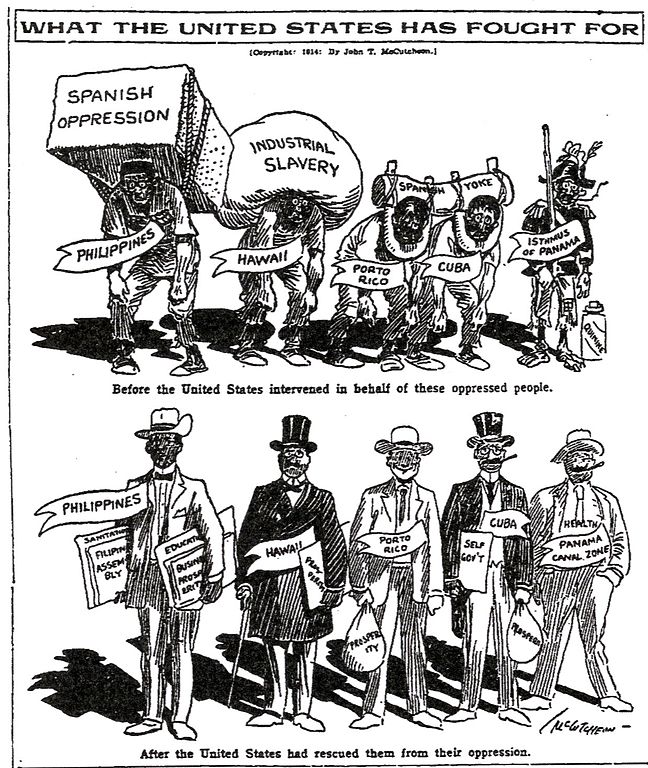
During the late 19th century leading into the early 20th century, American imperialism was on a rise. The idea of American imperialism, caused one of the largest debates in American history; the anti-imperialists versus the pro-imperialists.  Although there was lots of tension, this showed the pure and true effects of democracy by allowing a multitude of different opinions to disperse in the nation.  This cartoon titled, “What The United States Fought For”, justifies the reasons for imperializing lands like the Philippines, Hawaii, Puerto Rico, Cuba, and Isthmus of Panama.  The artist of this cartoon is clearly on the side of pro-imperialism and geared toward an audience of pro-imperialists. The use of symbolism and parallelism is quite evident in an attempt to justify American Imperialism.
The symbolism is seen as the different lands being shown as people. Each person on the top is holding some sort of ‘baggage’ or weight that is holding them down. For example, the Philippines is holding a box titled Spanish oppression, and Hawaii is holding a sack that says industrial slavery, and so on. The use of symbolism in this sense creates a dramatic effect of change that America helped in doing so.  The change from a weak, suffering, and tired person to a business person, is clearly quite huge, which is able to be seen through this symbolism.
Parallelism is also huge in this political cartoon.  Social Darwinism was very popular during this time period of American Imperialism, which played a huge role in the history of the United States of America. On the bottom half of the cartoon it shows the final stage of the lands, through the help of America.  These people (symbolic of the specific land) are changed into strong, wealthy, and proud businessmen. This is direct parallelism to the idea of Social Darwinism in the sense that America thought that the only way to really survive was to become strong and wealth and quite literally “Captains of Industry”.  The push for “survival of the fittest” played a huge part in American imperialism, and to some, justified the actions that happened during imperialism.
In my opinion I believe that the artist successfully proved their point by laying out both a sophisticated and unique argument. Although, I disagree with pro-imperialists and would probably side with anti-imperialists, this does not alter my view on the artist's effective use of rhetorical strategies in order to prove a point.